Jupiter Island Isn't One Real Estate Market. It's At Least Two.
September 3, 2026
September 3, 2026
Search "Jupiter Island homes for sale" and you'll get numbers that don't just differ, they contradict each other. One source puts the median sale at $7.4 million. Another says $1.7 million. A third lists it north of $18 million. These aren't old numbers pulled from different years. They're all from 2026, all labeled "Jupiter Island," and all describing something real. The problem isn't bad data. It's that "Jupiter Island" is doing double duty as a name, and most portals never tell you which market they're actually measuring.
If you're comparing Jupiter-area neighborhoods and trying to figure out what your budget buys, that distinction matters more than any single stat on the page.
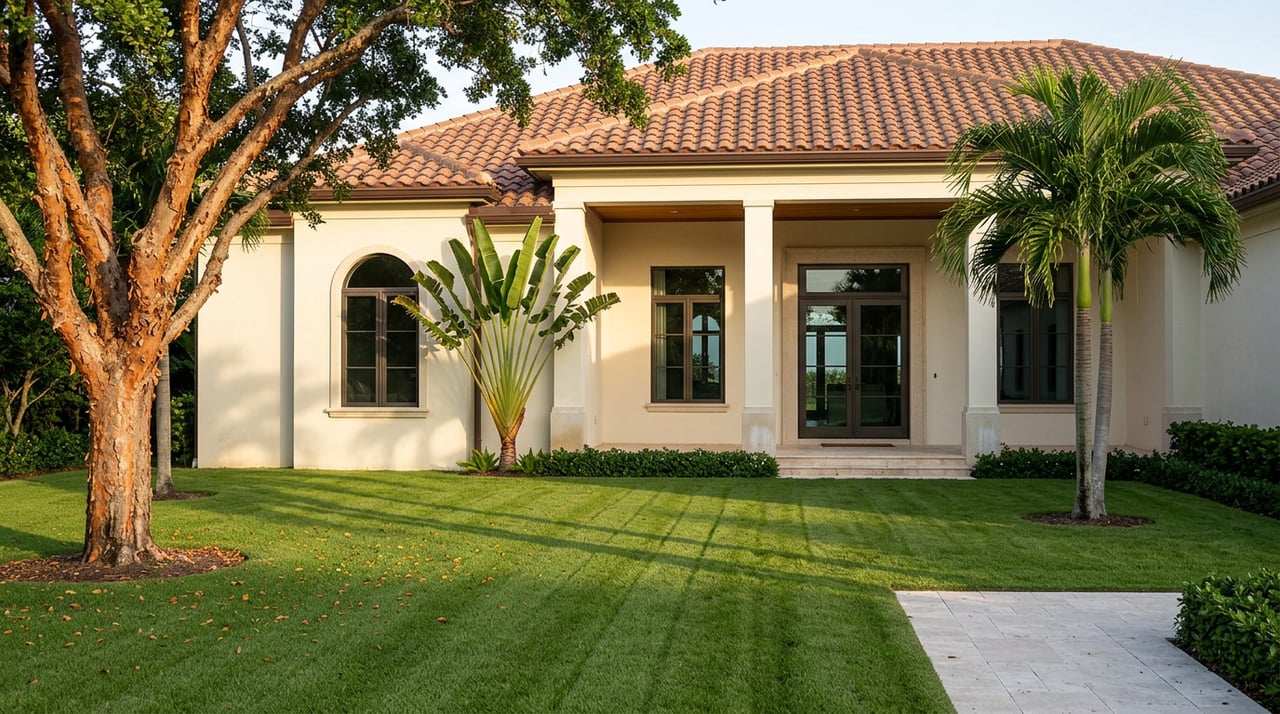
The incorporated Town of Jupiter Island is the barrier island most people picture when they hear the name: an estate community with roughly 512 single-family parcels and about 80 vacant residential lots spread across roughly 855 residential acres, much of it protected conservation land that can never be built on. At the island's south tip sits Jupiter Inlet Colony, a distinct pocket of about 230 quarter-acre lots, smaller and differently priced than the ocean-to-Intracoastal estate parcels that make up most of the town.
A few miles south, near Tequesta, a separate string of roughly 18 mid-rise buildings and 500-plus condo units also carries the "Jupiter Island" name, sitting on the same narrow strip of barrier land. These buildings run small by design, often two units per floor, with a mix of ocean and Intracoastal exposure in the same residence. It's a real product with real appeal, but it has almost nothing in common with the estate town other than geography and branding.
One platform's "Jupiter Island" neighborhood page will be tracking the condo corridor. Another's will be tracking the incorporated town. Neither will flag which one you're looking at.
Even once you sort out which Jupiter Island you mean, the pricing data keeps disagreeing with itself, and the reason says something useful about how thin this market really is.
In the three months ending May 2026, one major portal's town-level data showed a median sale price of $7.4 million, down 53.8% from the same period a year earlier, with price per square foot falling 42.7% to roughly $2,050. Over that same window, a separate neighborhood page tagged "Jupiter Island" under the city of Jupiter showed a median of $1.7 million, up 27.9% year over year, at $410 a square foot. One is almost certainly the estate town. The other, given a price per square foot that low, is almost certainly the condo corridor.
Move to a different data provider and the town-level number shifts again. Zillow's home value index put the typical Jupiter Island home at $9.13 million as of mid-2026, essentially flat year over year. Movoto's August 2026 snapshot showed a median list price of $12.7 million, down 24% from a year earlier, with homes sitting on the market a median of 147 days. A fourth site's March 2026 figures for Jupiter Island listings put the median at $18.8 million, with an active range running from $3.75 million to $45 million.
None of these providers are wrong. They're measuring different things. Some track closed sales, others track active listings, which in a slow, thin market skew toward whatever hasn't sold yet, often the priciest and longest-sitting inventory rather than what's actually trading. Some pull a trailing twelve months, others a single quarter. And in a town that closes perhaps thirty house sales in a good year, a handful of transactions at either end of the range can swing a median by millions. A "market that dropped 54% in a year" and a "market that's basically flat" can both be technically accurate descriptions of the same 512 parcels, depending entirely on which few houses happened to close during the window someone chose to measure.
That's worth sitting with if you're using an online median to calibrate a budget. At this scale, the median isn't a stable fact about the market. It's an artifact of which specific houses sold.
Whatever the momentary median says, the long-run story on Jupiter Island is not in dispute, and it's a cleaner illustration of scarcity than most coastal markets offer.
Median price per square foot on the island ran about $551 in 2016 and roughly $2,085 by 2026, nearly a fourfold increase over the decade. But that increase didn't drift upward evenly. Most of the move happened in a tight window between 2020 and 2022. In 2020, the island logged 69 qualified sales, the most in a single year on record, as buyers newly prized space and seclusion above almost everything else. That volume surge is the real trigger. With a fixed number of parcels and large sections permanently off-limits to construction, each of those 69 sales removed an opportunity that doesn't reliably come back. Houses on Jupiter Island tend to hold for decades once bought. The buyers who came after 2020 weren't bidding on a growing supply. They were bidding on what was left, and by 2022 price per square foot had roughly tripled against 2019 levels.
One sale traces the whole arc. A house that changed hands for $26 million in 2021 sold again, privately, in 2026, this time for $40 million, a gain of roughly 54 percent at a time when several high-end markets elsewhere in the country were softening. Nothing physically changed about the property or the island. What changed is that buyers understood, after 2020, exactly how fixed the supply actually was.
The other assumption worth checking before you compare Jupiter Island to other Jupiter-area communities: buying land here does not buy you into anything social.
The Jupiter Island Club, founded in 1958, sits at the center of the town but operates entirely apart from real estate ownership. Membership is by invitation, follows an application and interview process, and isn't published or guaranteed to come with a closing. That structure is different from what buyers typically encounter elsewhere in Jupiter. At Admirals Cove, club membership is required to purchase a home, full stop, with no path to ownership that skips it. At Jupiter Country Club, membership is bundled into the HOA and mandatory for residents. At Jonathan's Landing, it's the opposite: membership is optional and completely separate from owning property there.
Jupiter Island's model doesn't fit any of those templates. You can own an oceanfront estate here for decades and never be offered membership, and the home's deed will never tell you that going in. If club access, golf, or a specific social calendar is part of why you're drawn to the island rather than to Admirals Cove or the Bear's Club, that's a conversation to have before you write an offer, not after you close.
If your search budget sits in the $650,000 to low seven-figure range and you found listings under "Jupiter Island," you're very likely looking at the condo corridor near Tequesta, not the estate town. That's not a downgrade, it's a different product with real oceanfront and Intracoastal access, just built at a scale and price point the estate town doesn't offer.
If you're comparing the estate town's pricing against other Jupiter-area luxury communities, look past the headline median and ask what window it covers and whether it reflects closed sales or active asks. A single quarter's number in a market this thin tells you less than it looks like it does.
And if lifestyle access matters as much as the house itself, confirm in writing what comes with the property. On Jupiter Island, the honest answer is usually nothing beyond the land and the water.
Is "Jupiter Island" the barrier island town or the condo buildings near Tequesta? Both exist under that name. The incorporated Town of Jupiter Island is the estate community with roughly 512 single-family parcels. A separate corridor of about 18 condo buildings a few miles south also carries the name. Confirm which one a listing or a portal's data actually refers to before comparing prices.
If I buy in the Town of Jupiter Island, do I get access to the Jupiter Island Club? No. The club is invitation-only and functions independently of property ownership. Buying land on the island does not create a path to membership.
Why do median price figures for Jupiter Island vary so much between websites? Different platforms measure different things, closed sales versus active listings, a single quarter versus a trailing year, and the estate town versus the condo corridor. With only a few dozen town-level sales closing in a typical year, a small shift in which houses sold can move the reported median dramatically without reflecting any real change in the market.
If you're trying to figure out which Jupiter Island fits what you're actually looking for, and what a given budget realistically buys once you separate the estate town from the condo corridor, Kukla Partners Real Estate Group can walk you through the current inventory on both sides of that line. Contact us to talk through what you're seeing in your own search and what it actually means.
We pride ourselves in providing personalized solutions that bring our clients closer to their dream properties and enhance their long-term wealth.